The Science of Human Flourishing: What 200,000 People Across 22 Countries Taught Us About Living Well
What if everything we thought we knew about happiness was only half the story?
I recently went down a research rabbit hole on human flourishing—the kind of deep dive that involved 24 parallel AI research agents, 150+ peer-reviewed studies, and data from the largest flourishing study ever conducted. What I found challenged my assumptions and, I think, offers a more complete picture of what it means to truly thrive.
Flourishing Is Not Happiness (And That Matters)
Here's the first surprise: flourishing and happiness are not the same thing.
Aristotle called it eudaimonia—often mistranslated as "happiness" but more accurately meaning "living well and doing well." The distinction matters because optimizing for happiness alone can actually undermine flourishing.
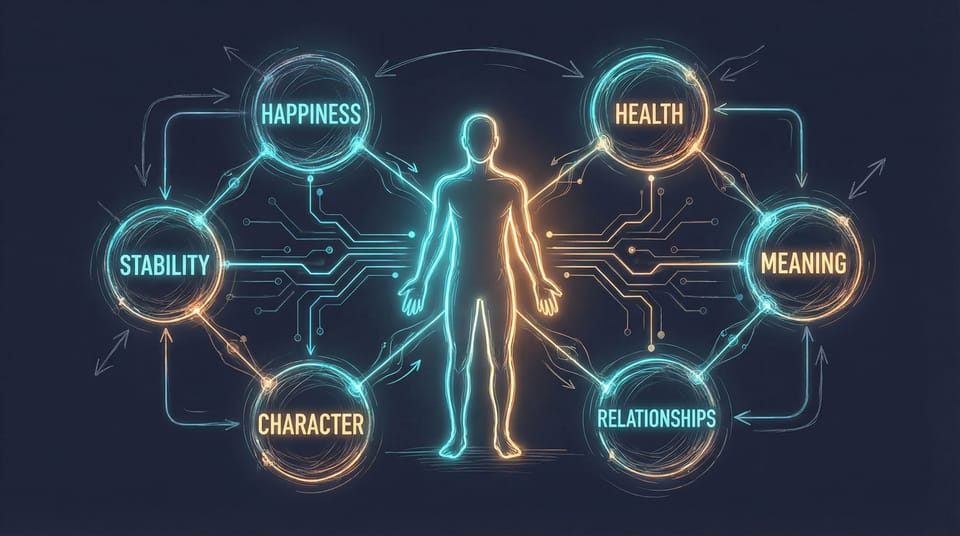
The Harvard Human Flourishing Program, led by Tyler VanderWeele, identifies six essential domains:
- Happiness and Life Satisfaction - Yes, positive emotions matter
- Mental and Physical Health - The body-mind connection is real
- Meaning and Purpose - Activities experienced as worthwhile
- Character and Virtue - Ethical behavior and delayed gratification
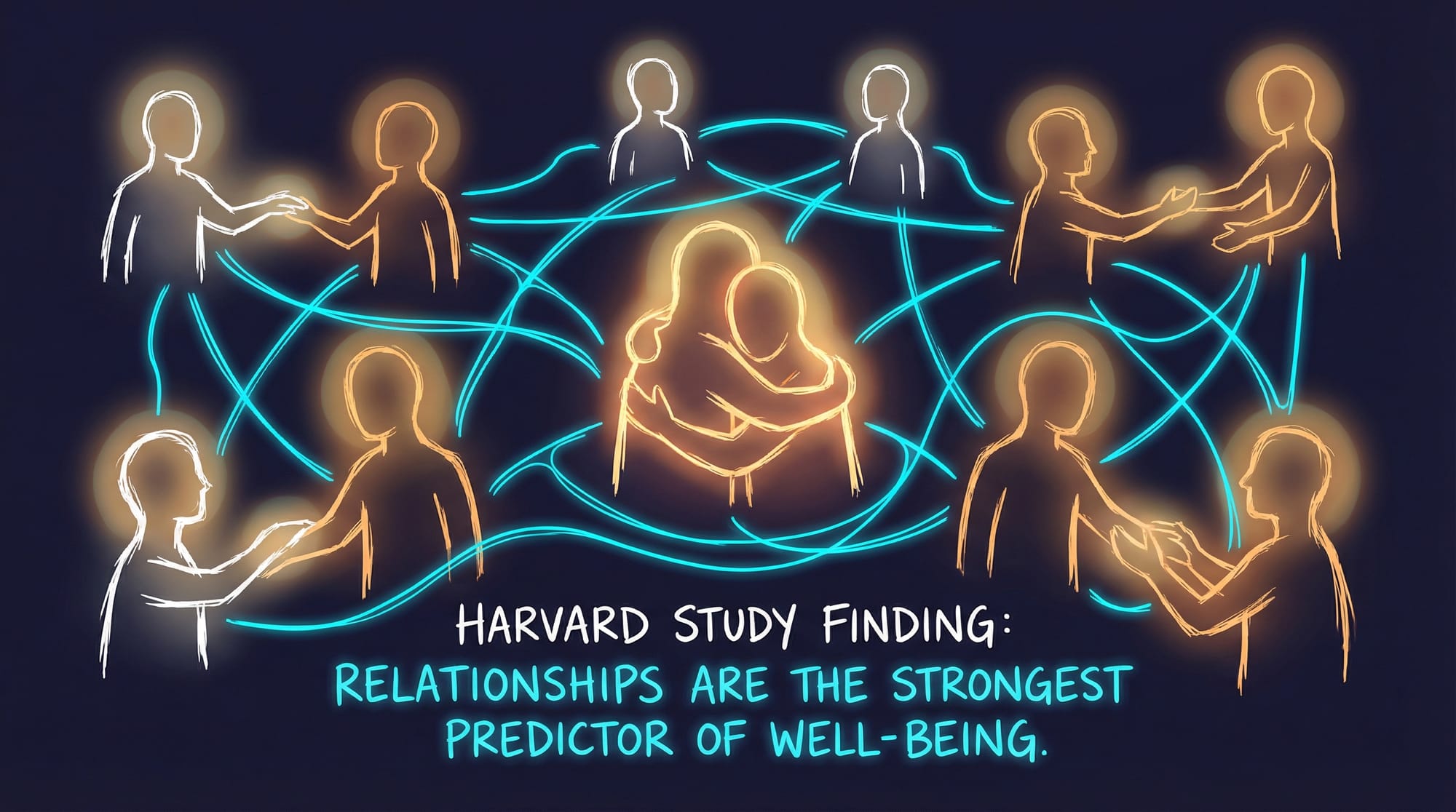
- Close Social Relationships - The strongest predictor of all
- Financial/Material Stability - Freedom from worry about basics
Miss any one of these, and you're not fully flourishing—even if you're happy.
The Wealth Paradox
The Global Flourishing Study surveyed over 200,000 participants across 22 countries. The findings were counterintuitive:
Wealthier nations scored higher on material well-being but lower on meaning, purpose, and relationships.
| Highest Flourishing | Lowest Flourishing |
|---|---|
| Indonesia (8.10) | Japan (5.89) |
| Israel (7.87) | Turkey (6.32) |
| Philippines (7.71) | UK (6.79) |
Sweden and the United States—among the world's wealthiest nations—ranked in the middle, with strong material satisfaction but weaker scores on what arguably matters most.
Relationships: The 85-Year Verdict
The Harvard Study of Adult Development has been tracking participants since 1938—85 years of longitudinal data. Their conclusion is unambiguous:
"Good relationships keep us happier, healthier, and help us live longer."
The numbers are striking:
- Relationship satisfaction at age 50 predicted health at age 80 better than cholesterol levels
- Married people live 5-12 years longer (women) and 7-17 years longer (men)
- Quality of relationships affects physical health through biological pathways (oxytocin, cortisol, inflammation)
And yet we're facing a loneliness epidemic:
- 1 in 6 people worldwide affected by loneliness
- 30% of young adults (18-34) report daily loneliness
- 26% increased mortality risk from chronic loneliness
In our 20s, quantity of relationships matters more. By our 30s, quality becomes paramount. The optimal number of close friends? About 5.
The Aging Paradox
Here's something that surprised me: subjective well-being often increases with age, despite physical decline.
Why? Older adults tend to have:
- Better emotional regulation
- Greater acceptance of life's imperfections
- A shift from competition to connection
- Contemplation of mortality that cultivates gratitude
The Japanese call it ikigai—your reason for being. The research suggests finding yours is one of the strongest predictors of healthy aging.
What Actually Works
Not everything marketed as a "well-being intervention" actually works. The research is clear about what does:
| Intervention | Effect Size | Notes |
|---|---|---|
| Mindfulness-based practices | g = 0.39-0.62 | Strongest for anxiety |
| Exercise + Psychological support | Largest combined | Synergistic effects |
| Character strengths training | Significant | Meta-analysis confirms |
| Social-Emotional Learning (schools) | +11% academic | Plus well-being gains |
| Workplace wellness | $4 ROI per $1 | When done right |
What doesn't work:
- Short-term happiness courses (effects fade within 1-2 years)
- Low-dosage programs
- Supplements without comprehensive approach
- Interventions without fidelity to design
The Structural Dimension
Individual choices matter, but so do the societies we live in. The strongest predictors of national flourishing are:
- Quality of social safety nets
- Functioning democratic institutions
- Low economic inequality
- High institutional trust
- Strong community/religious participation
The Spirit Level thesis—that more equal societies do better on nearly every metric—has been largely vindicated by 15 years of follow-up research. Income inequality correlates with higher homicide rates, worse mental health, and greater social stratification.
Flourishing isn't just a personal project; it's a collective one.
AI and the Future of Flourishing
This is where it gets interesting. AI is rapidly transforming how we understand and support human flourishing:
The Promise:
- Woebot (CBT chatbot) achieved FDA Breakthrough Device designation
- AI mental health apps market growing 24% annually
- Corporate wellness AI expected to reach $100.8 billion by 2032
- Harvard's AI and Flourishing initiative developing alignment benchmarks
The Peril:
- 60% of jobs in advanced economies exposed to AI disruption
- Work provides purpose beyond income—what happens when it's automated?
- Many AI mental health tools systematically violate ethics standards
- Risk of "simulated empathy" replacing authentic human connection
The critical question for 2026 isn't technical—it's spiritual, existential, and moral. Technology can serve or undermine flourishing; the outcome depends on human choices about governance, equity, and values.
The Flourishing Formula
Based on comprehensive research synthesis, here's what we know:
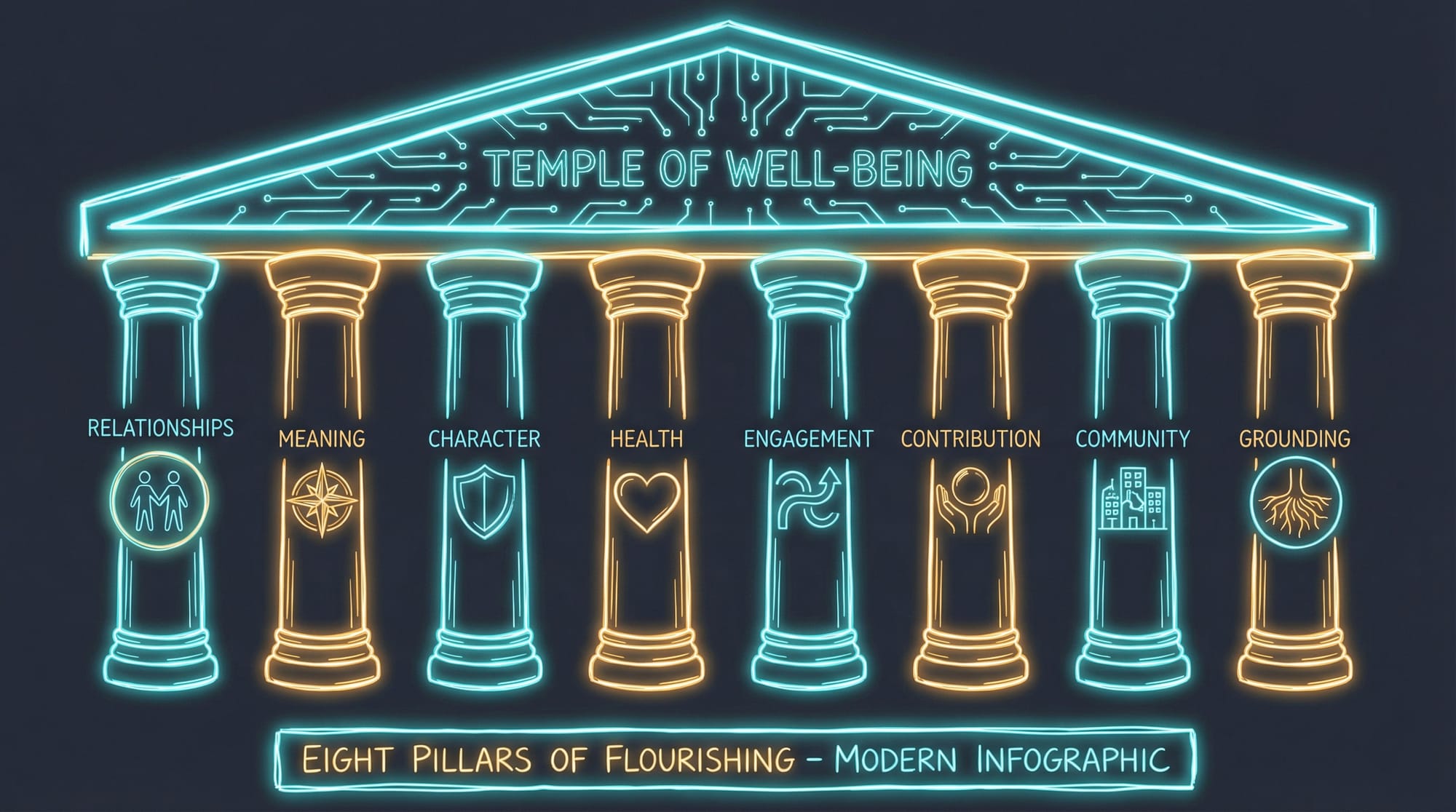
Eight Pillars of Flourishing:
- Cultivate deep relationships - Quality over quantity
- Find meaning and purpose - Beyond work alone
- Develop character strengths - Especially your signature strengths
- Maintain physical health - Exercise, sleep, nutrition as integrated system
- Seek engagement - Flow states and absorbed activity
- Contribute to others - Giving predicts well-being
- Build structural support - Community, institutions, safety nets
- Ground in meaning - Spiritual, existential, or secular
The Hopeful Finding
Here's what gives me hope: flourishing is learnable and developable.
Character strengths can be cultivated. Resilience can be built. Relationships can be deepened. Meaning can be found. The research points not to fixed traits but to skills and conditions that can be intentionally developed.
The VIA Classification identifies 24 character strengths organized under six virtues—wisdom, courage, humanity, justice, temperance, and transcendence. Meta-analyses of randomized controlled trials show these strengths can be trained, boosting both happiness and overall flourishing.
You're not stuck with the level of flourishing you have today. That might be the most important finding of all.
Research based on 24 parallel research agents, 150+ peer-reviewed studies, and the Global Flourishing Study (200,000+ participants across 22 countries). For the full research report and sources, see the flourish repository.